London Audiology Consultants

What We Do

Auditory Processing Testing

(About Auditory Processing Disorder; also referred to as Central Auditory Processing Disorder)

What is Auditory Processing Disorder (APD)?

For most individuals, listening skills develop naturally throughout childhood with practice and experience. However, people with auditory processing difficulties experience issues
in these listening pathways, making it harder for their brains to make sense of the sounds their ears hear.

In children, APD can show up in the following ways:

– Difficulty following instructions
– Trouble focusing especially in noisy environments
– Difficulty learning through listening
– Poor reading, spelling,
– Often asking, “What?”, or saying “I can’t hear you.” and “It’s too loud.”
– Not responding at all or responding with a significant delay when spoken to

In adults, APD can show up in the following ways:

– As a persisting disorder from childhood
– After a concussion or other traumatic brain injury
– In the presence of hearing loss

Common signs for all ages include:

– Difficulty listening, reading, and/or spelling
– Functioning well in quiet environments and struggling in the presence of noise
– Short attention span or easily distracted
– Difficulty putting things in order and organizing information
– Short-term auditory memory problems, such as difficulty with multi-step
instructions

If this sounds like you or someone you know, book an appointment for auditory processing testing!

APD vs ADHD (Attention Deficit/Hyperactivity Disorder)

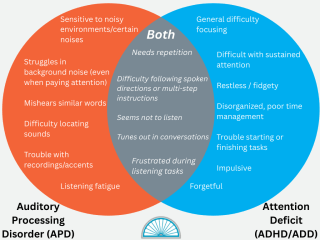
It is important to note that many individuals with APD also have ADHD, a neurodevelopmental condition that makes it difficult for a person’s brain to focus and control impulsive thoughts or actions. One or both conditions can exist in the same person. For people with both, treating APD can improve their ability to manage some of their ADHD symptoms, by improving confidence in responding, learning memory techniques, and practicing sustained attention. As such, an important part of investigating an ADHD diagnosis is confirming the presence or absence of APD as well. Though there are many similarities between individuals with APD and ADHD, there are also distinguishing factors between the two conditions:

How is Auditory Processing Disorder Diagnosed?

At London Audiology Consultants, we primarily use the Buffalo Model for diagnosing and treating auditory processing issues. This model, developed by Jack Katz, Ph.D., at the University of Buffalo, assesses how well a person processes auditory information. We evaluate patients aged 6 and older (with screening available for children aged 4 and 5) based on how their performance compares to established normative data across several listening tests. We also examine binaural separation and integration, which reveal how the brain processes multiple sounds presented at the same time. The tests measure a person’s abilities in four key areas:

  1. Decoding: The ability to quickly and accurately process phonemes, which are the basic sounds that make up speech.
  2. Tolerance-Fading Memory: The ability to understand speech in noisy environments and hold that information in short-term memory while processing other sounds.
  3. Organization: The ability to organize and store spoken information.
  4. Integration: The ability of the left and right brain hemispheres to work together in processing auditory information to properly understand a message.

A diagnosis of APD can be validation that there is a reason why you or your child struggle to follow along during a conversation. It also allows us to identify specific areas of difficulty so a unique treatment plan can be created. Our audiologists can also recommend accommodations for school, at home, in social situations, and in the workplace to help reduce the impact that your hearing/processing ability has on your life.

What Can I Do If I Have APD?

London Audiology Consultants offers both in-person or virtual treatment of APD. Treatment will be individualized and adapted based on identified areas of difficulty. Participants often see benefit in:

● Better comprehension in conversations around noise

● Easier listening in classrooms or group settings

● Increased confidence socializing and at work

● Less listening fatigue and frustration

Our treatment program is one of the only verified programs available in southwestern Ontario. Even if you are assessed somewhere local to where you live, this treatment program is still available to you.

Next Steps

If you or someone you know is struggling to follow conversations in noise, remember spoken instructions, and pay attention to what others say, you may have auditory processing disorder. Our audiologists can test, diagnose, and plan personalized auditory processing treatment to help you or your child improve listening skills, whether you have normal hearing, hearing loss, or post-injury processing issues.

Book Auditory Processing Testing Below!

Request an Appointment

We will be happy to find a day and time for you to consult with one of our audiologists.